Why Every Portfolio Must Be Hedged — The RiskFirst Way to Survive Market Crashes
Why a Portfolio Should Be Hedged. Always.
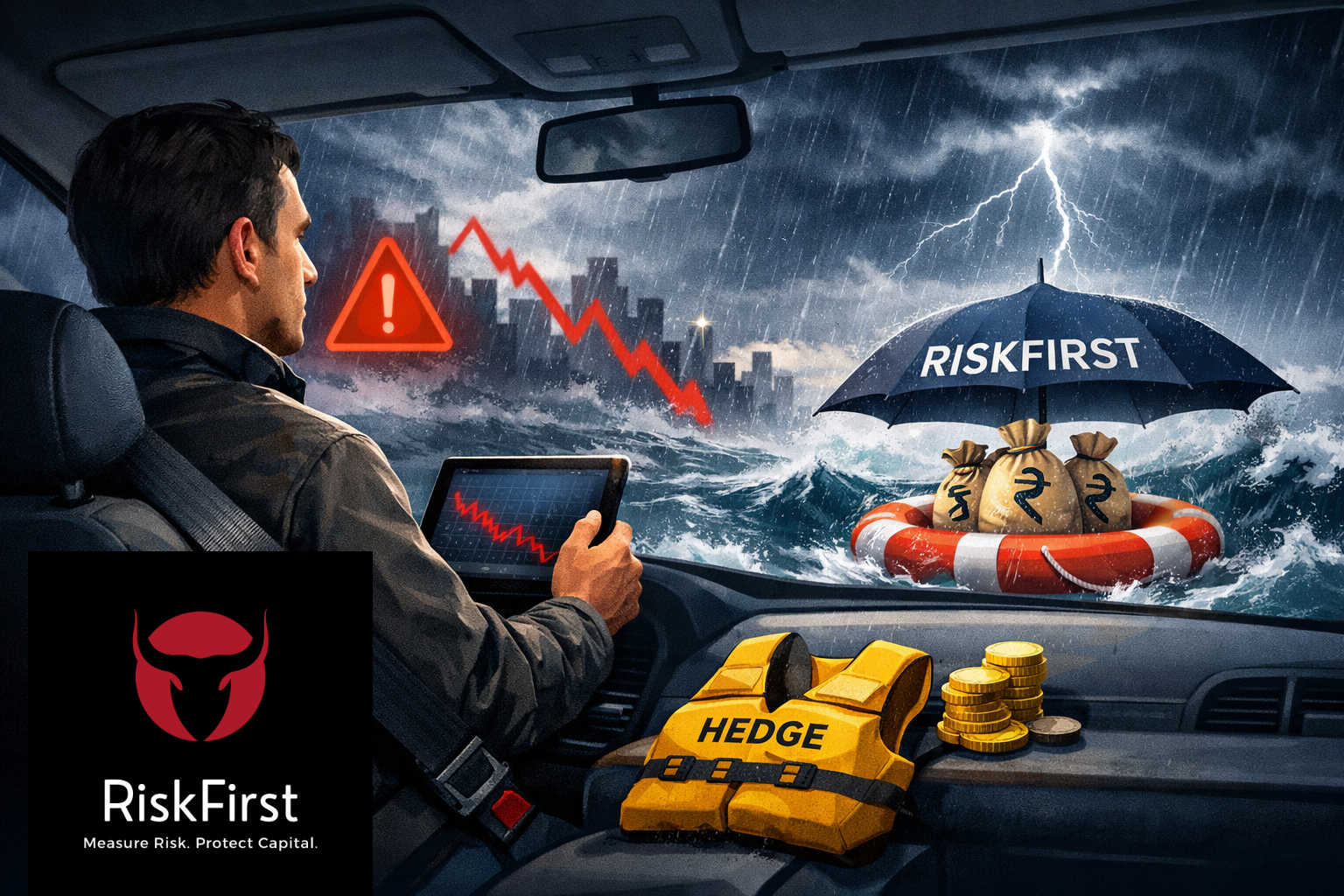
Most investors treat hedging like an umbrella.
They carry it only when the sky looks dark.
That logic fails in markets for one simple reason:
storms arrive before clouds.
Crashes are not polite. They do not give warnings. They do not wait for consensus. They arrive overnight, in gaps, in cascades—when your screen is off and your emotions are unprepared.
A portfolio without a hedge is like driving fast without a seatbelt.
You may enjoy smoother rides.
But one accident can end the journey.
Hedging is not pessimism.
It is engineering for reality.
The Compounding Problem Nobody Talks About
A 10% loss needs an 11% gain to recover.
A 30% loss needs a 43% gain.
A 50% loss needs a 100% gain.
Losses are nonlinear.
They punish you more than gains reward you.
Compounding works only when drawdowns are controlled.
Large losses don’t just hurt—they break the math of recovery.
Unhedged portfolios assume:
“I will be right often enough.”
Hedged portfolios assume:
“I will be wrong sometimes—and I refuse to be ruined when I am.”
That difference determines who stays in the game.
Why Diversification Is Not Enough
Diversification works in normal weather.
In storms, everything leaks.
During market panics:
- Correlations rise
- Liquidity disappears
- “Unrelated” assets fall together
- Good businesses drop with bad ones
Your carefully diversified portfolio begins to behave like a single fragile bet.
A hedge is not about picking better stocks.
It is about protecting the system that holds them.
It introduces something that wins when stress appears—
when volatility rises, when markets fall, when fear spreads.
That is when protection matters.
Hedging Buys You What Money Alone Cannot
In a crisis, investors don’t just lose capital.
They lose options.
They sell at the bottom.
They abandon plans.
They stop thinking.
A hedge does three things:
- Caps damage – you know the worst-case outcome.
- Creates liquidity – protection often rises when everything else falls.
- Stabilizes behavior – you can think, not panic.
Hedging does not predict the future.
It makes you resilient to it.
Always Means Before You Need It
If you hedge only when you feel nervous, you hedge too late.
Protection is cheapest when nobody wants it.
It is expensive when fear is already in the price.
That is why “always” matters.
Just as you do not fasten a seatbelt after impact,
you do not build protection after volatility arrives.
Hedging is a small, continuous cost to avoid a discontinuous loss.
The RiskFirst Principle
Traditional investing asks:
“How much can I make?”
RiskFirst asks:
“What happens to me if I am wrong at the worst possible time?”
Hedging is how that question becomes operational.
It accepts three truths:
- Uncertainty is permanent
- Crashes are inevitable
- Survival is everything
The goal is not to avoid losses.
The goal is to avoid irreversible losses.
A portfolio should be hedged always
for the same reason buildings have foundations,
planes have redundant systems,
and cars have brakes.
Not because disaster is certain.
But because it is possible—and costly.
In markets, winners are not those who predict storms.
They are those who are still standing after them.