Scrap Prices in India: Why They Change Daily | IndiaRecycle.in

One of the most common questions in India’s recycling ecosystem is simple: why do scrap prices change every day? For scrap generators, the movement often feels unpredictable. For recyclers and buyers, it is the natural outcome of market forces, demand cycles, and operating costs.
Scrap is not fixed-price waste. It is a secondary raw material, and like any commodity, its value changes continuously based on supply, demand, and cost structures.
Scrap Is a Commodity, Not Waste
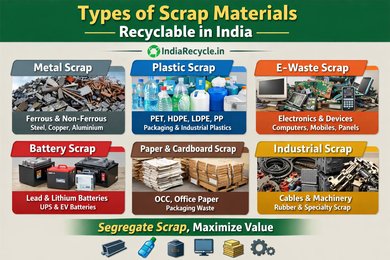
Scrap prices move because scrap behaves like an industrial input. Steel, copper, aluminium, plastics, and batteries are traded based on replacement cost, availability, and downstream demand. This makes daily price variation normal rather than exceptional.
Global Commodity Markets
International commodity markets influence Indian scrap pricing, especially for metals. Movements in global exchanges, currency fluctuations, and changes in international demand directly impact domestic scrap rates, sometimes immediately and sometimes with a short delay.
Domestic Demand from Recyclers and Mills
When steel mills, smelters, and processors increase production, scrap demand rises and prices strengthen. When plants slow down or inventories build up, prices soften. In most cases, domestic demand has a stronger influence than scrap availability itself.
Quality, Grade, and Segregation
Two scrap lots of the same material can attract very different prices. Purity, contamination, moisture, and consistency of grade play a major role. Well-segregated scrap not only commands better prices but also moves faster through the recycling system.
Logistics and Fuel Costs
Transportation is a significant cost component in scrap trade. Changes in fuel prices affect pickup costs and inter-state movement, directly impacting net realization for both buyers and sellers.
Regional and Seasonal Factors
Scrap prices vary across India due to proximity to recycling hubs, industrial density, state regulations, and local demand. Seasonal factors such as monsoons, year-end inventory adjustments, and policy changes can create short-term volatility.
Why a Single “Today’s Rate” Can Mislead
Asking for one scrap rate without context ignores grade differences, quantity, logistics, and payment terms. In many cases, working with the right recycler delivers better results than chasing the highest quoted price.
The Role of Better Price Discovery
As the sector evolves, price discovery is shifting from informal phone-based systems to structured visibility-driven models. Digital platforms do not fix prices, but they improve access to buyers across regions and categories, increasing transparency and reducing dependence on intermediaries.
How IndiaRecycle.in Helps
IndiaRecycle.in enables businesses to discover recyclers and service providers by material and location, connect directly without brokers, and make informed decisions. The platform focuses on access and visibility rather than price control.
Final Thoughts
Scrap price fluctuation is not randomness. It is market behaviour. Businesses that understand the drivers make better decisions, reduce risk, and build long-term recycling partnerships. Scrap value is maximized through knowledge, visibility, and structure.